
Diamond Certificates: The Fifth C
In this context, a fifth C is often mentioned, which stands for “Certificate.” Independent diamond institutes such as the Gemological Institute of America (GIA), the Hoge Raad voor Diamant (HRD), or the International Gemmological Institute (IGI) assess the quality of diamonds based on the four criteria listed above.
Each diamond receives an individual certificate documenting its quality according to these four criteria. The institutes do not assess the actual monetary value of the diamond. Instead, the certificate serves as the basis for price determination between buyer and seller. It contains detailed information about the characteristics of the certified diamond. The internationally recognized quality standards provide security and transparency for both parties.
Origin of the Name
The word diamond is derived from the Latin word diamantem, a variant of the Greek word adámas (meaning “invincible”).
1. Carat – Weight
The weight of diamonds is measured in carats, where 1 carat (abbreviation: ct) equals 0.2 grams. A diamond weighing 1 gram therefore weighs 5 ct. While diamonds are available in various intermediate sizes, there are typical diamond sizes that are particularly popular among buyers and jewelers.
The smallest cut diamonds weigh 0.01 ct. The well-known round brilliant cut is only available for stones weighing at least 0.05 ct.
Diamond Sizes
Diamonds weighing 0.25 ct are referred to as quarter-carat diamonds. Popular intermediate sizes include 0.30 ct stones and the one-third carat at 0.33 ct. Half-carat diamonds (0.50 ct) and the famous one-carat diamonds (1.00 ct) are considered classics. Their prices are significantly higher than those of smaller stones.
To better visualize diamond sizes, you can view a PDF overview of diamond sizes.
2. Color
In rare cases, nature produces diamonds that are pink, red, blue, green, yellow, orange, or black. Depending on the intensity of the color, different classifications apply. Color intensity has a decisive influence on the value of the diamond.
Fancy Color Classifications:
F – Faint
VL – Very Light
L – Light
FL – Fancy Light
F – Fancy
FI – Fancy Intense
FV – Fancy Vivid
FD – Fancy Deep
FD – Fancy Dark
The Influence of Fluorescence
Under UV light, many diamonds exhibit an effect similar to a white T-shirt in a nightclub—they glow. The intensity of this phenomenon, known as fluorescence, is classified as none, faint, medium, or strong. Fluorescence can be considered a negative characteristic, as it may cause some diamonds to appear milky or cloudy. In certain colored diamonds, however, fluorescence can have a positive effect depending on the color and overall appearance.
3. Clarity
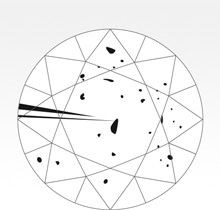
The fewer inclusions of foreign material found within a diamond, the higher its clarity. The purer—and thus freer of inclusions—and clearer a diamond is, the more valuable it becomes. The price increases exponentially with higher clarity grades.
“Flawless” is certainly the best-known term associated with diamond clarity. A diamond is considered flawless when no inclusions are visible even under tenfold magnification. While larger inclusions (from clarity grade PI2 onward) can be seen by the naked eye, smaller inclusions are only visible to experts using a loupe. The following internationally recognized clarity classifications apply:
| Abbreviation | Meaning | Explanation |
|---|---|---|
| IF | Internally Flawless | Loupe-clean except for possible surface marks from processing |
| VVS1 / VVS1 | Very, very small inclusions | Inclusions extremely difficult to detect even at 10× magnification, even for experts |
| VVS2 | Very, very small inclusions | Inclusions extremely difficult to detect at 10× magnification |
| VS1 / VSI | Very small inclusions | Inclusions very difficult to detect at 10× magnification for trained professionals |
| VS2 | Very small inclusions | Inclusions difficult to detect at 10× magnification |
| SI1 | Small inclusions | Inclusions detectable at 10× magnification by trained professionals |
| SI2 | Small inclusions | Inclusions detectable at 10× magnification but not with the naked eye |
| PI1 | Piqué I | Inclusions barely visible to the naked eye, brilliance not significantly affected |
| PI2 | Piqué II | Inclusions visible to the naked eye, brilliance affected |
| PI3 | Piqué III | Inclusions clearly visible to the naked eye, brilliance significantly reduced |
Types of Inclusions
Inclusions are generally divided into two categories: inclusions of foreign material and surface blemishes.