
Antwerp – Inside the synagogue, everything is silent. The hustle and bustle outside on the street fades away as the heavy door falls shut. An Orthodox Jew wearing a shtreimel, a fur-trimmed hat, enters the access code for the visitor and sets down his shopping bags beside the lectern just as his phone rings. He says he likes to come here when nothing is happening, to switch off for a few minutes. That is all. The young man does not wish to reveal anything more about himself. He simply did not want to deny an interested guest the sight of this beautiful, nearly hundred-year-old house of worship, with its grand chandelier and magnificent Torah ark. Discretion—absorbed here with mother’s milk—is everything in the diamond business.
In Antwerp, it all began with the Jews. Barred from practicing crafts in the Middle Ages, they turned to trade—among other things, in diamonds. No other European city integrates Jewish culture so naturally into its urban landscape to this day. Around the railway station known as the “Railway Cathedral,” tradition merges seamlessly with the brilliant business. And it is Jewish customs that set the tone in the industry. The city’s four diamond exchanges are closed on the Sabbath and Jewish holidays; two even house kosher restaurants. And two diamond dealers—whether in Antwerp, New York, Dubai, or Shanghai—always seal a deal with the words “Mazel u’bracha”: luck and blessing.
Those words are heard especially often on Hoveniersstraat, where the synagogue is wedged between plain, functional buildings. This is the heart of the global diamond trade. Eighty percent of the world’s rough diamonds pass through this street; for polished stones, the figure is about half. Some 34,000 people make their living from the diamond business here. Behind facades devoid of glamour, annual turnover reaches €51.9 billion. Every day, diamonds worth €200 million come and go. And yet—where are they? Nothing sparkles here.
The windows in the large hall of the Beurs voor Diamanthandel face north. The less sunlight enters, the easier it is to assess a stone’s color and clarity. The diamond exchanges were originally created so that valuable goods would not change hands under everyone’s gaze in a station café. Today, the once-secure trading venue has increasingly become a social meeting place. Since nearly every dealer now has their own office, fewer deals are actually concluded in the hall itself.
The notice board displays the latest information. Who has applied for membership—and thus access to the diamond exchange? Many of the index cards bear Indian names; traders from India now make up more than half of Antwerp’s dealers. Beside them hang perhaps a hundred yellow and blue slips listing the names, addresses, and misdeeds of those expelled from the global glittering community. “Trust is everything in this business,” says Barbara Descheemaecker of the Antwerp World Diamond Centre, the industry’s umbrella organization. “If you abuse it, you are out forever.”
Not only do these extremely valuable stones change hands solely by handshake and a spoken “Mazel.” One display case even contains notices announcing that stones have been found or lost on the street. Diamonds are often carried by traders in an envelope in their trouser pockets. “That’s how they walk around,” Descheemaecker continues. “And when they take out their house keys or wallets, diamonds occasionally fall out.”
Seven hundred video cameras ensure that no one slips one into their pocket unnoticed. “The street is more closely monitored than NATO headquarters in Brussels,” says the industry representative. “The moment someone sets foot on it, we already have a perfect 3D image of them.” Police cars are equipped with cameras on their roofs. A guard post at the entrance to the diamond district checks all valuables transports; for each one, the bollards must be lowered. The area was sealed off after a car bomb was detonated in front of the synagogue in 1981 in the name of the Palestinian cause. Three people were killed, dozens injured.
The diamond industry has gladly accepted the additional security ever since. “We,” says Caroline de Wolf, spokesperson for the diamond association, “do absolutely everything we can for security.”
All the greater was the shock over the crime of February 19—a case that remains the talk not only of the city, but of the world. Television crews from the United States, Asia, and Australia are currently flocking to the Belgian port city on the Scheldt to report on the diamond heist. “With almost military precision,” as de Wolf describes it, eight men disguised as police officers breached the security perimeter at Brussels Airport just as diamonds from Antwerp were being loaded onto a plane bound for Zurich. “They must have known about this one vulnerable moment.” Stones worth €37 million from Hoveniersstraat were stolen.
On the day itself, the outcry was unmistakable. Now, the message is a different one. “The main thing is that no one was hurt,” is the official line of the diamond association. Besides, not even a quarter of a day’s turnover was lost—and the insurance will cover it anyway, de Wolf reports. Asked whether the global attention Antwerp has received might not more than compensate for the €37 million loss, she merely laughs, somewhat embarrassed.
The reputation of the world capital of diamonds has not suffered—quite the opposite. The sheer intensity of desire expressed in such a mad act only reinforces the diamond’s status as the ultimate luxury good. For what else would inspire a script so cinematic that comparisons with the master thieves of the Hollywood film Ocean’s Eleven are already circulating? Surely only for the hardest material on the planet, formed over millions of years, cut to shine and sparkle—and capable of striking more than a few women straight in the heart.
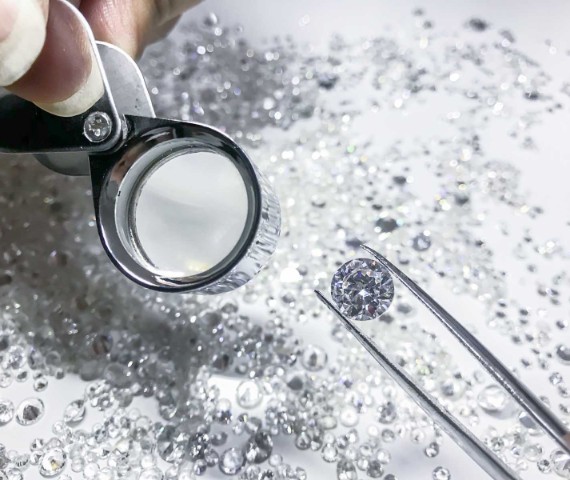
Under the microscope in the umbrella organization’s laboratory, this can be seen clearly. Eight hearts appear as reflections in the observer’s eye. Turn this particular brilliant cut upside down, and the corresponding arrows come into view. It is one of many tests carried out in Antwerp to determine a stone’s value. The staff do not learn what that value actually is—for their own protection. They also do not know the names of the owners, to prevent bribery attempts. The small plastic trays holding individual gemstones are labeled only with anonymous barcodes. From one station to the next they go, with repeated counts to ensure that none of the employees has pocketed a diamond. The stones are assessed according to the four English Cs: carat, clarity, color, and cut.
The cut is done by Johan Olieslagers. In his workshop on the sixth floor, overlooking Hoveniersstraat, dull pebbles are transformed into sparkle. The 49-year-old prefers grander words: “I bring the stone to life.” It takes around three working days at a diamond-studded grinding wheel to turn a rough four-carat stone into a one-carat brilliant with its 57 facets.
The raw stones are brought to him by diamond dealers—or Olieslagers travels himself to Sierra Leone to source beautiful stones directly at the origin. That promises not only adventure, but also higher profits by cutting out intermediaries. He makes the trip to Africa four or five times a year. Since 2000, stones brought back to Antwerp require a so-called Kimberley Certificate, intended to guarantee that they are not “blood diamonds” whose sale finances violent conflicts. On Hoveniersstraat, Belgian customs check this very closely.
Johan Olieslagers belongs to a dying breed. Of nearly 40,000 diamond cutters in the 1970s, only 834 remain today. The business is shifting to China and India. The passing down of the profession from grandfather to father to son—as in Olieslagers’ case—is no longer the norm. “As a small boy, I had to sweep diamond dust out of the yard behind our workshop, and every now and then I found a larger piece of diamond—there were sweets as a reward.” At least among his twin children, he senses a similar enthusiasm.
In Antwerp, there will likely still be work for them. The “Antwerp cut” is still considered the finest and most expensive. “Diamonds became an investment object during the financial crisis,” says Caroline de Wolf. “But investment is limited to flawless stones.” Stones from Antwerp—and accordingly, prices are rising. The past two years have been the most successful in the industry’s history. The diamond fever continues to grow.