
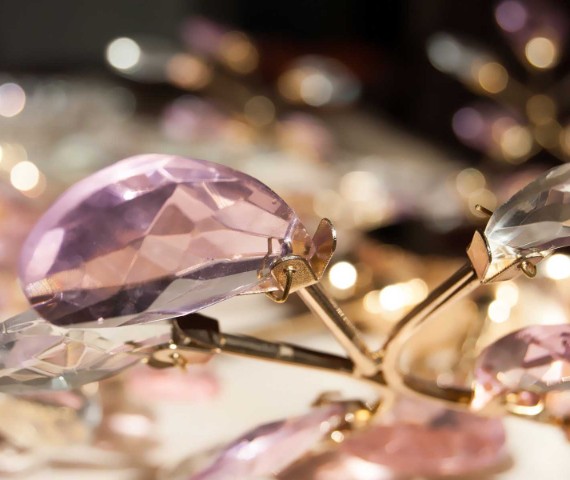
They are the icon of glamour and beauty. Even Marilyn Monroe was a “material girl” and appreciated the enduring value of tightly compressed carbon – at least on screen. “Diamonds Are a Girl’s Best Friend”, her song from Gentlemen Prefer Blondes, is virtually a hymn to gemstones as an investment. As Lorelei Lee, she thinks ahead to a time when superficial attractiveness fades and, with it, both major and minor attentions lose their value. Then, hard currency is what counts. In light of the euro crisis, less glamorous investors see it much the same way.
Reinhard Paul knows his way around gold and platinum, pearls and gemstones. The special passion of the jeweller from Nuremberg’s prestigious Kaiserstraße, however, lies with diamonds. Since 1985, Paul has worked as a publicly appointed and sworn expert for jewellery, particularly diamonds and coloured gemstones. He is also chairman of the German Diamond Club – and of course he knows that the lady of one’s heart can certainly be pleased by smaller stones as well.
Paul describes jewellery in which valuable diamonds are artfully set as an “accessory to the personality of the wearer.” It is no longer only women in Europe or the United States who appreciate these precious stones; women – and their wealthy husbands – in China, India and the Arab Gulf states are also discovering the appeal of diamonds.
Diamonds often bought “just for the safe”
For months now, diamond expert Paul has observed growing demand for diamonds “that are purchased purely for storage in a safe.” In his view, not only precious metals such as gold and platinum, but also gemstones like diamonds can serve “as an investment in the sense of long-term capital preservation.” According to Paul, prices for very small and small brilliant-cut diamonds “virtually exploded” last year.
Various specialists expect price increases of between 21 and 32 percent over the next five years. For 2012 alone, the industry is forecasting a value increase of around seven percent. Jeweller Paul recalls: “In 1970, a fine one-carat diamond could still be bought for the equivalent of around 4,000 dollars. Today, the market value is around 15,000 dollars – and in absolute top quality, even double that.”
Investment advisers around the world have discovered the advantages of diamonds. As an investment, diamonds compress great value into the smallest possible space, complementing other tangible assets with a “portable and stable emergency reserve.” However, unlike gold or platinum, their value cannot be determined on a daily basis. There are no official prices quoted on diamond exchanges.
Getting two thirds of the price is often already a good outcome
Unsettled investors who, in uncertain times, are primarily seeking stable tangible assets and are therefore also considering diamonds should heed the warnings issued by experts and consumer advocates. How unsuitable diamonds are as a short-term investment is usually realised when investors attempt to convert the jewels back into cash quickly.
Anyone who receives more than two thirds of the original purchase price after a short period is often already doing well, as VAT and the dealer’s margin – typically charged by professional buyers – can amount to around one third of the price or more in the case of jewellery. Some diamonds are virtually unsellable to begin with. According to observations by the Nuremberg diamond expert, many gemstones of “inferior quality” are also in circulation.
Consumer advocates at Stiftung Warentest explicitly warn inexperienced diamond buyers who lack specialist knowledge of the risk of losses. While investment diamonds priced from 2,500 to 50,000 euros and more are currently being promoted as crisis-proof investments with impressive returns, consumer advocates consider them largely unsuitable as speculative short-term investments.
Fraud cases in the diamond trade are increasing
In addition, cases of fraud in the diamond trade are on the rise. Repeated warnings are issued about disreputable sellers who attempt to pressure mostly unsuspecting victims via advertisements or telephone calls into buying expensive, shrink-wrapped stones accompanied by elegant and authentic-looking certificates. To reassure buyers, they are even offered a buy-back guarantee – naturally only if the gemstones are returned in their original sealed packaging. Impossible. In order to assess their value, experts must remove the stones from their packaging and examine them thoroughly.
Ultimately, the “four Cs” determine a diamond’s value: carat for weight, clarity for purity, colour for hue and cut for workmanship. Colour is the most important quality criterion, as it has a particularly strong impact on price, since other factors such as cut, clarity and weight directly affect colour. Large gemstones are far rarer than small ones. Accordingly, five one-carat diamonds can never achieve the price of a single five-carat stone.
Unlike gold, there is no classic purity standard for these sparkling gemstones. Prices for rough diamonds (uncut stones) have risen almost continuously over the past 50 years, and forecasts suggest they will continue to increase over the next five to ten years. At the same time, deposits are expected to shrink. Pessimistic projections even assume that the supply of rough diamonds could be exhausted within the next 20 to 30 years.
In the opinion of diamond expert Paul, investors have made the right decision if they view diamonds “from the perspective of a long-term investment.” Jewellery, however, is never a speculative asset and should never be subject to short-term thinking. Artfully cut gemstones remain, first and foremost, jewellery. “The most beautiful interest they yield is the daily joy and the sparkle in the eyes of the wearer.”