
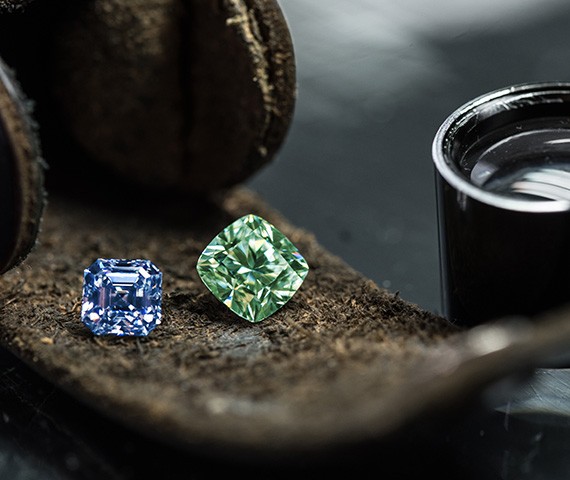
Diamonds are suitable both as a gift and as an investment. In addition to their emotional return—the joy of the recipient—they often achieve substantial increases in value years after purchase. However, buyers must look very closely and seek sound professional advice.
Demand Exceeds Supply
Given today’s historically low interest rates, neither German government bonds nor savings accounts offer any meaningful returns. Equity investments, on the other hand, are sometimes associated with significant price volatility.
“Diamonds, by contrast, are a crisis currency with relatively low price fluctuations,” says Arnim Kogge, wealth advisor at Vertiva Family Office in Stuttgart.
The expert refers to a study by the management consultancy Bain & Company, which predicts strong value appreciation for diamonds through 2020. The reasons are easy to understand, even for non-experts. “It has been decades since the last diamond mines were developed,” explains Kogge. Only a few new mines are expected to come online, while demand for precious stones remains high. And where demand exceeds supply, prices rise—this is the basic principle of a market economy.
Flawless Diamond Auctioned for €22 Million
Perfection in its purest form: one of the world’s largest diamonds was recently auctioned in New York. The gemstone is considered a masterpiece—though its size has become a real challenge.
Source: N24
Nevertheless, consumer advocates urge caution. Savers should not allow themselves to be tempted too quickly, says Ariane Lautenbach of Stiftung Warentest. There is by no means any guarantee of price appreciation.
Moreover, many disreputable dealers operate in the market, selling grossly overpriced diamonds to unsuspecting buyers—stones that can later be resold only for a fraction of the original purchase price. “Anyone without specialist knowledge should keep their hands off diamonds,” Lautenbach advises.
No Regulated Market for Diamonds
Thomas Schlüter of the Association of German Banks also advises restraint. “For private investors, diamonds are fine as jewelry, but not as an investment,” says Schlüter. Unlike stocks, there is no regulated market for diamonds. Their value is not determined daily, as is the case with gold or platinum. There are no official price listings—ultimately, a diamond is worth only what someone else is willing to pay for it.
Achieving a good price may therefore require time, Schlüter explains. In most cases, diamonds cannot be quickly converted into cash. “Diamonds should never be purchased as a substitute for a savings account, traditional interest-bearing investments, or even retirement provision,” the expert warns.
However, diamonds can certainly be suitable as a portfolio component. Long-term wealth protection is always based on the principle of diversification, and tangible assets are an essential part of such portfolios. Due to the uncertainties of modern financial markets, asset managers often recommend investing up to 20 percent of one’s wealth in tangible assets. Compared to gold and silver, diamonds have a major advantage: their relatively low weight. A one-carat stone weighs just 0.2 grams, making storage easy.
Certification Is Crucial
So what should consumers look for when deciding to purchase a diamond? First and foremost, an internationally recognized certificate helps identify genuine diamonds.
“Diamonds must absolutely come with a certificate,” says diamond expert Kogge. This certificate should be issued by an international gemological institute such as the Gemological Institute of America (GIA), the Hoge Raad voor Diamant (HRD), or the International Gemological Institute (IGI). While there are other reputable institutions, such as the German Diamond Institute, these typically carry only national significance.
The Most Expensive Diamond of All Time
Twelve million euros: with a single hammer strike, the “Graff Vivid Yellow” became the most expensive diamond ever sold in Geneva. The yellow gemstone is also the largest of its kind.
Source: Reuters
As a general rule, relying on certification from one of the major institutes is advisable because the price achievable upon resale depends heavily on the quality of the certificate. “The basic rule is this: anyone who makes compromises at the time of purchase will pay for them at the latest when reselling,” says Katja Herrmann, managing partner at diamond investment company Diamondstoxx. “It is at resale that it becomes clear whether you bought well—and, above all, with which partner.”
A certificate first answers questions regarding the so-called “4 Cs,” which determine a diamond’s value: Color, Clarity, Carat (weight in carats, where one carat equals 0.2 grams), and Cut. Only the correct cut gives a diamond its brilliance. The angles must be perfectly calculated to ensure optimal light refraction.
The cut alone also determines whether a diamond becomes a brilliant—the most precious and expensive form of diamond. Because the required craftsmanship is extremely demanding, the significantly higher prices are easy to explain.
Keep your hands off “Blood Diamonds”
In addition to quality grading, diamond certificates contain several identifying features to ensure that the expert assessment actually refers to the specific gemstone. These include details such as dimensions and proportions. Information on fluorescence is also included.
“Each certificate is also numbered,” explains Herrmann. The GIA, for example, engraves this number on the girdle—the edge separating the upper and lower halves of the diamond. “That alone is reason enough to check not only the gemstone, but also the accompanying certification,” Herrmann emphasizes.
Buyers should also verify the origin of the sparkling jewels. Diamonds must come from legitimate sources and cutting facilities and must not be so-called “blood diamonds,” whose sales have historically financed wars waged by African dictators. Since the implementation of the Kimberley Certification Scheme, only diamonds from countries committed to exporting conflict-free diamonds may be imported into the European Union. Although loopholes still exist, diamonds from conflict regions are taboo—not only for moral reasons, but also because they are a poor investment, as resale often involves significant price reductions.
It is best to consult a neutral expert when assessing a diamond’s value. “A layperson cannot judge the value of a stone; proper training is required,” says Dieter Hahn of the diamond cutting company Ph. Hahn Söhne in Idar-Oberstein. He advises purchasing diamonds exclusively from reputable jewelers or goldsmiths. “In such cases, an independent expert assessment is usually included in the purchase price.”
With Diamonds, Value Goes Beyond Material
Ultimately, it must be noted that for jewelry, not only the material value matters—manufacturing costs must also be factored in. As a result, the purchase price of jewelry is typically higher than its intrinsic value. Anyone considering a diamond necklace as an investment may therefore need to wait several years before reselling it at a profit.
That said, diamonds are generally better suited as jewelry worn around the neck, on fingers, or in ears than locked away in a safe. After all, they please the eye most when worn—and not only in the glow of Christmas candles.