
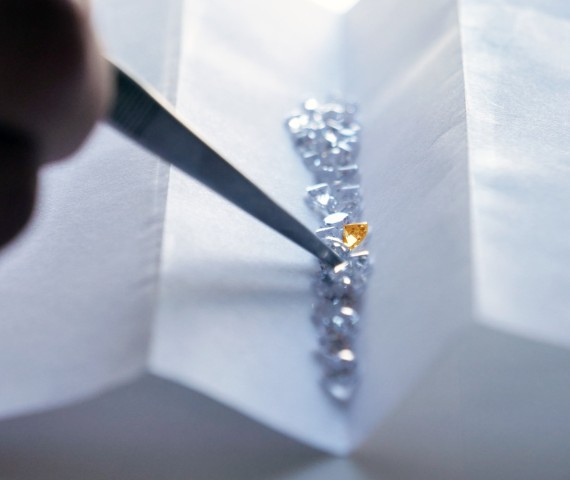
At the peak of the Ukraine crisis, gold prices did rise sharply for a time. Yet most investors chose to take profits. Holdings were withdrawn from the SPDR Gold Trust: in the second week of April alone, outflows totaled 9.3 tonnes. By comparison, that amount roughly matched all the inflows into the fund recorded earlier in the year.
More recently, gold prices have recovered somewhat. At their peak, they rose by 1.2 percent to a three-week high of USD 1,315 per troy ounce. Still, the image of gold as a safe haven has begun to show cracks. As a result, investors may want to consider another, equally sparkling asset: diamonds.
Since the 1960s, prices for rough diamonds have increased roughly tenfold. Compared with the previous year alone, their value rose by around 13 percent. This is according to the Global Diamond Report 2013 published by consulting firm Bain & Company. On average, diamond prices have increased by 5.2 percent annually. Looking ahead, further gains appear likely.
The reason is straightforward: diamonds are not only highly sought after, but also scarce. “Demand for diamonds will certainly continue to grow,” says Dieter Hahn, head of Germany’s oldest diamond-cutting company. In particular, demand is rising in China and Russia, explains the CEO of Ph. Hahn Söhne in Idar-Oberstein. In those markets, interest is increasingly shifting toward higher-quality stones. “Until now, lower-priced diamonds with discolorations have been more common,” Hahn says. As demand rises, prices tend to follow.
At the same time, supply is tightening. The number of diamond mines is declining, and few new deposits are being developed. This is confirmed by Philippe Mellier, CEO of De Beers, the world’s largest diamond producer and trader, which accounts for around one-third of global rough diamond output. According to Mellier, enormous quantities of earth now have to be moved to uncover a single diamond.
De Beers estimates that global demand for diamonds will grow by 4.5 percent this year. Bain & Company expects demand to double by 2020.
To help meet this growing demand, an entire industry producing synthetic diamonds has emerged. These stones are virtually indistinguishable from natural diamonds to the naked eye and cost only about a third as much. Nevertheless, they are not considered a serious threat to prices for natural diamonds.
There are two reasons for this. First, synthetic diamonds do not share all the material properties of natural stones and are therefore unsuitable for certain industrial applications. Second, they are not an attractive alternative for the affluent clientele that purchases natural diamonds.
Experts therefore arrive at a clear conclusion: for investors, diamonds offer tangible advantages over gold and silver.
A Stable Alternative
Unlike precious metals, diamonds are not a mass investment. Shortages or market distortions like those seen in gold are therefore less likely. In addition, diamonds are the hardest and most durable material known, with a significantly higher melting point than precious metals. As a result, they are highly valuable for industrial use, as well as in research and medical applications.
Another appealing feature is portability. Assets worth millions can, quite literally, be carried in one’s pocket. Moreover, diamond values tend to be stable, and there is consistently demand for high-quality stones. The market is also dominated by relatively few players, which helps support prices.
For investors, diamonds can thus represent a stable alternative to the currently more volatile gold market. However, only a limited number of stones are suitable as investment assets—and they are not appropriate for those with a short-term horizon.
Dieter Hahn recommends holding a diamond for at least five years before selling. Buyers must pay value-added tax at the time of purchase, which means that selling only becomes worthwhile after a certain period. In addition, potential investors need substantial expertise. “Without a reputable partner, purchasing diamonds is not advisable,” warns the German Association of the Precious Stones and Diamond Industry. For lay investors in particular, the diamond market is difficult to navigate, as each stone has a unique value.
Diamonds, however, are not reserved exclusively for wealthy investors. Some stones are available for just a few hundred euros. The general rule is simple: the purer the stone, the higher the price.
A one-carat diamond with impurities and a brownish-yellow tint can cost around one euro. By contrast, a transparent, flawless one-carat diamond can be worth around EUR 10,000. “Classic round stones sell best,” Hahn says, “in fine white or better. The stone must also be flawless and accompanied by a suitable certificate.”
Such certificates are issued, among others, by the German Diamond Institute, whose experts also assess a diamond’s value.
This task is far from straightforward, as each diamond is unique. For this reason, diamonds are not traded on stock exchanges.
Anyone wishing to buy diamonds must therefore turn directly to a dealer. Hahn advises against online retailers: “There is no personal contact, and unlike jewelers or specialist dealers, they generally do not buy the stones back.”
Investors who prefer exchange-traded instruments can consider diamond-focused funds or shares in mining companies. One example is the Canadian-listed company Aber Diamond (ISIN: CA0028931057), which generates around two-thirds of its revenue from industrial diamonds, with the remainder coming from its jewelry subsidiary Harry Winston. Anglo American (ISIN: GB00B1XZS820) may also be of interest to investors; the mining and commodities group has held an 85 percent stake in diamond producer De Beers for the past two years.